Life

You are currently browsing articles tagged Life.

Once when I was about ten years old, I was poring over a brochure for travel to Greece that ended up in my family’s home. I was very interested in examining the details of each island advertised in the brochure, and the various reasons for going there. I remember being especially intrigued by one island (the name of which I forget) which had sounded distinctly industrial and un-touristy, but the indefatigable travel agents that had authored the brochure wrote that it could be of interest to “island buffs”. My ten year old brain marvelled at this: island buffs! I wanted to be an island buff and go to this mysterious island that had only one line of text devoted to it, where the other islands had whole paragraphs extolling the virtues of its beaches and resorts.

Having this “island buff” latent within me as a much older person, I read with some interest about the demise of an island in Second Life, the virtual community created by Linden Labs. I’ve long been a Second Life skeptic, unsure I’d become quite bored enough with First Life to bother with a Second. At the zenith of Second Life buzz, it seemed like everyone was crafting an avatar or buying an island (except me). After the hype, it’s interesting to see where things end up, and so I found this highly entertaining missive from Scott Shamp, Director of the New Media Institute at the University of Georgia, quite fascinating:

UGA purchased the NMI Island in 2007. We wanted to explore the potential of virtual worlds. Over a thousand avatars (virtual versions of people) representing students and people from all over the (real) world teleported in to visit. We hosted a virtual tailgate Fridays before gamedays where alum could meet students – the firework shows were spectacular. [...] And I taught class on the island. In my 21+ years on the faculty, that had to be the weirdest teaching experience. Try focusing on your lecture when students spontaneously fly away. [...]

But on Wednesday, 9/10, our experiment ends. You see LindenLabs, the company that runs SecondLife, is a for profit company. It costs $1700 a year for us to own our island – and that is with a 50% educational discount. Yes, I have one of the bravest deans ever. Dean Clark actually signed a purchase order for “One Island.” We discovered that you can sole source an island, but a continent will have to go out on bids.

Everybody is feeling the economic pinch these days and UGA is no different. With looming budget cuts threatening crucial services, an island is a luxury we just can’t afford. We didn’t renew so Linden Labs is pulling the plug on the NMI island.

And here is one of the most unfortunate aspects of virtual worlds. Unlike a web page that we can download and store on local hard drives, everything that we built only works in SecondLife. So we can’t save it. Frankly, that sucks. So everything from the 300 foot virtual Arch, to the flashing dance floor with a giant aquarium, to the incredibly realistic football field, to the beautifully executed virtual GA 400 will be erased.

Though Scott puts a brave face on it, this is actually quite sad. An institution of learning developed an online research project and because of some typical corporate short-sightedness on the part of Linden Labs, the University will walk away with nothing. No momentos, no souvenirs. No “I bought an island in Second Life and all I got was this lousy t-shirt” t-shirts. Professor Shamp and his students will have little other than a few screenshots to remember their Second Life experiment by, and this reminded me of another, richly-rendered island community that was envisioned not in Second Life, but on paper:

Urville, imagined as an island metropolis for 12 million inhabitants, begun when Tréhin was only five years old, is a triumphant example of a city made up almost from nothing. Tréhin’s own guidebook to the city includes hundreds of perspectival pencil drawings; these depict, in often astonishing detail, recognizable buildings and building types that have been combined to form a cityscape that itself exceeds recognition.

With imaginary spaces like the Square des Mille Astres, the Gare d’Italie, and the Place des Tégartines, Urville’s visual appearance could perhaps be described as a kind of Belgian Venice, crossbred with Chicago, as master-planned by Baron Hausmann for an upstart hotelier in Las Vegas. In other words, the city is derivative; it is a collection of landmarks. One can make out the Sears Tower, the Rialto Bridge, the Grande Arche de La Défense, and what could easily pass for New York’s World Trade Center towers—among many other sites on the global tourist circuit—but what Urville lacks is a human face.

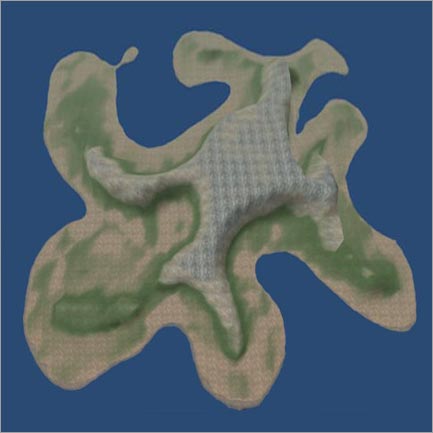
The problem of a “human face”, both offline and online, remains the most difficult to solve. With a click of a mouse, the hard work of many students is erased from Second Life, leaving only the American Apparel outlet and whoever else is rich enough to maintain a virtual presence in the proprietary world of Second Life. Despite dozens of sketches, the author of an imaginary island community quotes the greats and yet cannot capture what makes urban living great. The island buff in me, meanwhile, remains more inspired by real micro-nations and micro-states, and a long-lost Greek island from a tourist catalogue. (Image: A typical Second Life island.)


As I cultivate relationships across a wide variety of web 2.0 platforms, I am increasingly asking myself what the relationship with each “connection” or “friend” means. For example, it’s very clear what it means on LinkedIn — either we did business together, or would like to do business together, or at the very least, met in a professional context. It gets a bit muddier on Facebook, where I have “friended” people I went to grade school with as well as current close friends, and professional colleagues. Twitter, which I will refer to as a micro-blog platform for ease of understanding, is a particularly intimate place for me where I have sometimes denied connecting with people that I know, because I intentionally want to keep that community small.

Twitter is where I might just blurt things out, and even though it is in the realm of possibility that one of my Twitter connections might pass my “tweets” on, it is highly unlikely. So amid the wild seas of web 2.0 and the trends of exposing everything, I have attempted to carve out a space where I can quietly mutter to myself (and trusted associates) and hope it will all be fine.

Regarding Twitter and so many of these other web 2.0 services, the sense of timing is pivotal. My “tweets” on Twitter seem hardly relevant the next day, since they might have been referring to something so specific to a moment. Also in a space where you are limited to 240 characters, it can be difficult to be explicit about what you are referring to, though read in the context of the time of day, or based on how quickly a tweet appears after another may provide other clues.

I looked back through my archive and found a few recurring themes and somewhat interesting thoughts which I thought I’d share here, with everyone, a random selection of what I share in what I consider to be my online “safe space”:

  • Eagerly anticipating the haircut.
  • Getting excited about tomorrow’s opening at Canada House.
  • Unwinding.
  • Looking for recipes involving polenta.
  • Sitting on a pile of Krugerrands.
  • Planning + plotting.
  • Watching the rugby at a pub in Manchester.
  • Evolving into a true microwave gourmet.
  • Really irritated by Imogen Heap’s voice and wishing last.fm would quit playing her.
  • Terrible weather outside contributing to productivity inside.
  • Unable to shake hangover.
  • Trying to remember how to do proper MLA citation.
  • Waxing poetic.
  • There is the biggest rainbow outside my train window as Arcade Fire crescendoes in my earphones – I love life.
  • Looking at food porn.
  • Thinking of naming my imaginary band “Incompetent Terrorist”.

It’s all fairly unremarkable, like everyone else’s tweets. In fact, you would only care about them if you really cared about me. For me, I suppose, that’s the allure of a service like Twitter: I have finally found a place in the web 2.0 world where it might really simply just be about sharing in an honest, open way, with people who might give a damn. And that feels good.