art

You are currently browsing articles tagged art.

I find myself in the same situation time and again when I arrive at a major international festival: too many events happening at once! Spoilt for choice! Unable to decide if I should go to one talk or another, which are of course happening at the very same time in different locations!

The programme for this year’s FutureEverything festival is so overflowing with juicy content, that perhaps you too will suffer this dilemma. In the face of such a cornucopia of content, there is something for everyone, but maybe you want to peek over my shoulder and see what I’ve circled in red on my FutureEverything diary? (Oh and hey, I wouldn’t mind you sharing your picks with me too!)

Music:
Ryoji Ikeda – test pattern [live set] / Mika Vainio [live]: “complex audio-visual terrain” … “analogue warmth and metallic harshness”
Konono No.1 [live] / Bass Clef [live] / Jon K: “a thundering sonic attack of 21st Century African music that sounds like nothing ever heard before”
Moldover [live] / Atau & Adam [live]: “a performer who combines the charisma of a rock star with the mad genius of a basement inventor”

Conference:
GloNet: “an experimental format happening simultaneously in five cities around the globe: Manchester, Sendai, Istanbul, Sao Paulo, and Vancouver”
Shaping the City panel discussion: how are cities shaped by climate, culture, and citizen participation?
Keynote: Ben Cerveny: “taking us from 1960s Situationist ideas to current collaborative interaction in public spaces”
Keynote: Keri Facer: “Learning to live in uncertain times”
New Creativity panel discussion: “How do we play, collaborate, and create in a way that makes a real impact on the world?”
McLuhan in Europe 2011 – inaugural lecture with Darren Wershler: “describing the fascinating connections between McLuhan’s predictions and declarations”

Art:
The Feast of Trimalchio: Stunningly beautiful, UK premiere
Eyewriter: a pair of low-cost glasses & custom software that allow artists and graffiti writers with paralysis to draw using only their eyes
Cu Exhibition: “diverse and experimental contemporary art from both national and international artists”

Get tickets!


I’m pleased to say that the full programme for the FutureEverything conference for 2010 is out. It is our best and most ambitious yet. We are also delighted to present the world’s best speakers under our conference themes of ImagineEverything, Unlimited Connectivity, Open Data and The City Experiment.

12-15 May 2010, Manchester, England. Obtain your festival passes now here: http://futureeverything.org/tickets

The FutureEverything conference will take you on a journey through the most cutting-edge developments in a range of exciting fields. Join us to hear about why governments should open up the data that they hold, and what we can do with this information to change our lives. Listen to leading artists and scientists discuss what we can dream and do with unlimited bandwidth. Visionary speakers will illuminate the science of the web, the ways the networked city is being rewired, how poetry can be encoded into DNA, ways we can play the city like an instrument, and how relationships between generations are going to change over the next hundred years.

Read the rest of this entry »

An sample of Jeremy Bailey's artwork for In-Site Toronto.

In-Site Toronto is a series of newly commissioned work that will be presented on the portal pages of several wireless internet hotspots in the Wireless Toronto network until the end of 2010. Artists Dave Dyment, Swintak, Jeremy Bailey, Fedora Romita, Willy Le Maitre and Brian Joseph Davis have created works that will be automatically displayed when users log in to their Wireless Toronto user account at designated hotspots. The project was launched on March 31, 2010 in partnership with Spacing Magazine. The project was produced by media arts organisation Year Zero One, was curated by myself, and was produced with the support of the Canada Council for the Arts. The downloadable, printable, shareable e-catalogues that are available at each hotspot were produced using bookleteer by Proboscis.

Now, go out, use your free Wireless Toronto account, and discover some art that relates to the place where you are and our contemporary digital age.


View In-Site Toronto in a larger map

Recently, I gave a talk at transmediale as part of their Free Culture Incubator series. I’ve embedded the video below. I highlighted three case studies that I think exemplify how advocating for the arts successfully can make profound differences to how we experience urban spaces.

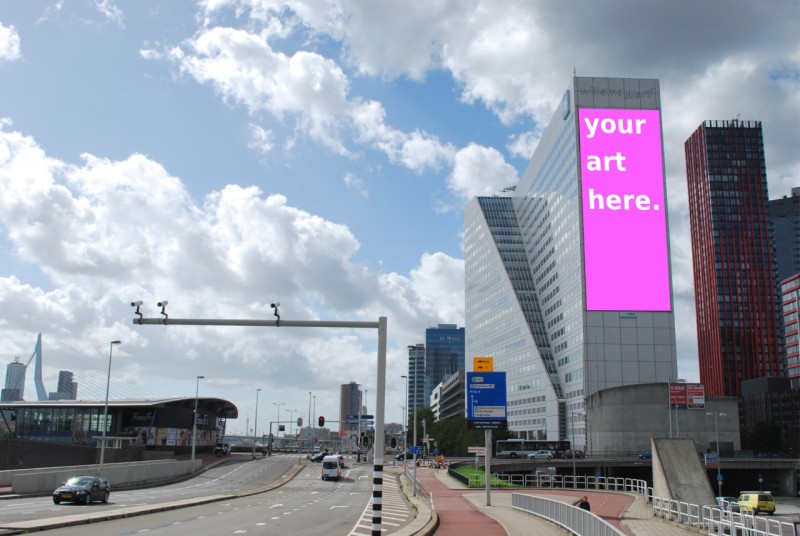
Firstly I mentioned BeautifulCity.ca, a campaign to introduce a billboard tax in the city of Toronto, with the tax money distributed to art and culture projects. They were very successful in winning the first battle, which was implementing the tax, but now they need people to speak up once more in favour of how the budget is actually allocated. Check out their Facebook event for more details on how you can help this terrific project.

I also mentioned Ile Sans Fil, the wireless community group that I used to work with, that built a grassroots infrastructure in Montreal that is wildly successful. They were also pioneers of using their infrastructure as a platform to distribute art and community content to their users. They have been so successful at building infrastructure and in their advocacy work that wireless internet infrastructure is now an issue in the Montreal municipal elections.

Last but not least, I mentioned Manchester Open Data City, a huge initiative by FutureEverything. FutureEverything is leading the advocacy around making Manchester the UK’s first open data city, by identifying data that can be made available, and looking at issues of data interoperability, quality and management. I’m programming the FutureEverything conference this year, and can tell you that Open Data and its implications for citizen participation and creativity will be a hot topic. Hope to see you in Manchester this May for FutureEverything!


Paul McCarthy, Painter. Video, 1995.

I participated in a panel discussion at the National Galleries of Scotland just over a week ago, entitled: “Unreliable Narrators: Artists, Curators, Editors”. The other panelists were Colin Fraser, editor of Anon, a poetry journal that only accepts anonymous submissions, and Ryan Van Winkle, currently Reader in Residence at the Scottish Poetry Library. Daniel Herrmann, Curator of the Paolozzi Collection and Works on Paper at the Scottish National Gallery of Modern Art moderated.

Daniel Herrmann opened the panel by showing a clip from Paul McCarthy’s 1995 video, Painter, which is currently on view at the Dean Gallery. As the exhibition text states: “Painter is shown next to the Dean Gallery’s own ‘Paolozzi Studio’. This partial reconstruction is an educational stage-set, exhibiting the generous donation of Scottish artist Eduardo Paolozzi (1924-2005), and is one of our most popular and successful displays. By contrasting the Studio presentation with McCarthy’s critique, ‘Painter’ and The Studio casts a second glance at how museums present the making of art.”

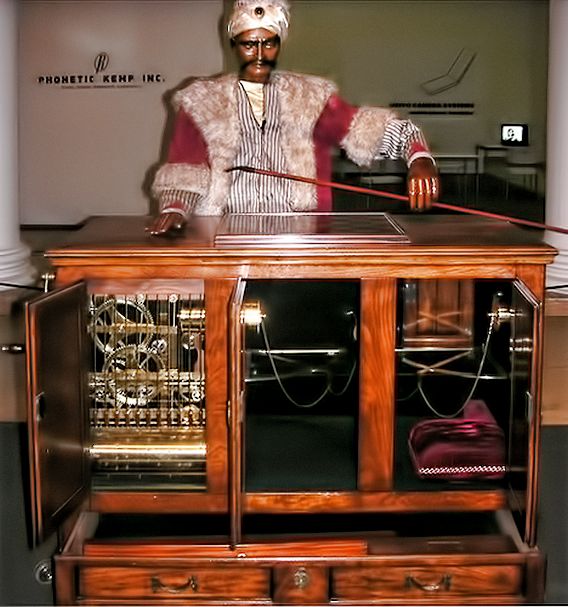
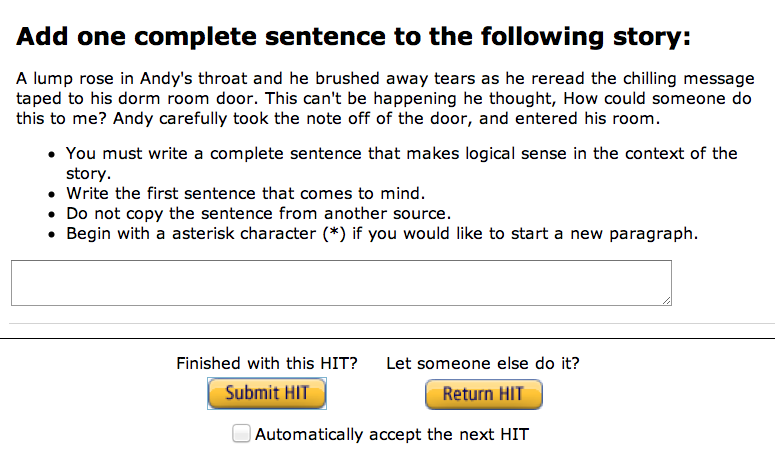
We then discussed models of authorship and control. I presented the contemporary example of Bicycle Built for Two Thousand, a project by Aaron Koblin and Daniel Massey. Koblin and Massey collected over two thousand human voice samples that were then assembled into the song Daisy Bell, which has historical significance as this was the song performed in the first example of computer voice synthesis. The participants were recruited through the Amazon Mechanical Turk, had no idea what they were participating in, and were paid $0.06 for their contribution. The nature of the contributions made via the Mechanical Turk service, while only possible on this scale in our contemporary networked age, also somewhat mirrors a traditional studio model where apprentices create building blocks that are refined and completed by masters. McCarthy’s video challenges image of the painter as lonely genius. The new networked possibilities for art are not so far from old models of participation (not collaboration), but reveal them and remind us of their timeless utility, while also firing a volley at the “lonely genius” stereotype.

My Skin and The Du Cane and Boehm Family Group. After Gawen Hamilton 1734-2000, by Graham Harwood

As I was cleaning out my books and magazines over the holidays, I came across an old issue of Tate magazine from Winter 2000. “William Blake”, the cover exclaims, resonating somehow with a recent column at the Guardian that argues that William Blake was the quintessential British artist, and perhaps the greatest British artist of all time. “Getting Drunk with Gillian Wearing” was another line of text that caught my eye, and then I noticed “The net value of virtual art”, and decided I had to stop sorting and cleaning and open up the magazine.

The article, entitled “Art dot com”, written by Paul Quinn, takes up a healthy six pages, and starts out at the Whitney Biennial. Quinn comments on the presence of “the internet” at the Biennial, “that most private of public spaces” (well, this was years before Facebook’s Mark Zuckerberg declared privacy was so, well, 2000). He observes a teenager navigating the websites on view at the Biennial with “yawning dexterity” and repeats the oft-repeated tale that the teenager exclaimed “”Can we, like, go? We can do this at home”" after a few minutes of weaving through the sites on offer.

Quinn observes that “sometimes the technology cuts the gallery out of the equation”, a statement that might seem quaint today, ten years later. After describing works such as Mark Amerika’s Grammatron and Darcey Steinke’s blindspot and their reliance upon tried and true narrative, he moves on to one of my favourite new media works, John F. Simon Jr’s Every Icon, a masterwork that I believe has stood the test of time and that Quinn felt leaves viewers “contemplating the infinite”. He notes in his conclusion that it’s “hardly surprising, then, that much existing internet art becomes a commentary on existing genres – narrative, painting, minimalism – and that, as so often with innovation, the novelty is in the combination or recontextualising.” Noting that some while some will find “losses” others will find the notion of technological intervention in art a “democratising, demystifying” force, the article takes a halfway-house stance common at the time, as the jury was simply out on what impact the internet and the world wide web would eventually have.

In one of the many “best of” lists that circulated as 2009 dissolved into 2010, the Telegraph listed the opening of Tate Modern in 2000 as one of the “top 100 defining cultural moments of the decade“. Today Tate Modern is viewed, by nearly every metric, as an outstanding success, with a massive presence and significance. Tate Modern itself was a significant part of Graham Harwood’s Uncomfortable Proximity, another masterwork of early internet art that was mentioned in Quinn’s article, and that Michael Alstad and I curated into one of our early online exhibitions, Pixel Plunder©.

Uncomfortable Proximity provided alternative websites to Tate’s own, remixing and subverting artworks in the collection (as seen in the image above) and providing new texts, uncovering elements in Tate’s history that, as Quinn put it, Tate would “erase from its official PR”. The text written by Harwood on his version of the Tate Modern site states:

“Tate Modern is Britain’s new national museum of modern art. As class compositions change, each new economic force takes over the mantle of British taste. Each succeeding social elite must have its art, its brand around which secret codes and systems of value can be exchanged. This is usually in the form of what is to be tolerated and what is not, what’s in and what’s out, who’s in and who’s out. New money needs to be part of history. With money you can buy your way into art history. With even more money you can shape the future of that history.”

Ten years later the novelty that Quinn found in internet art has long worn off, and this quote from Graham Harwood underscores that even then, some weren’t at all distracted from the real forces that will always shape the world at large, including the art world – namely, money. Matthew Fuller wrote an essay we commissioned for the Pixel Plunder© online exhibition and stated: “Is talent important in net art? This group of works gives us the answer. Let us remember that the name Talent was that of an ancient coin. What is a coin but a condensed power to take something out. The possibility to move a thing, an action, a power, from one state into another, to magnify, to set in motion, to store up or to kill. To set something aside, to make it separate.” As I look forward to the next ten years of technological innovation coupled with the production of culture, I will continue to bear in mind that though root agendas continue to be developed elsewhere and dictate the terms, and did so even in the crucible of the “democratising, demystifying” force of ten years ago, there is always room to develop something unexpected, beautiful, surprising, and even effective.

powerof8.org.uk

powerof8.org.uk

On October 12, the third This happened Edinburgh event will take place at the Wee Red Bar. Our exciting line up includes: Peter Pratt, Michael Salmond, Sarah Drummond & Lauren Currie, and Paul Rodgers & Euan Winton, and Anab Jain.

Tickets are available now at this site. Be fast — last time tickets sold out in under an hour! The event is sold out! If you want to follow all the This happened Edinburgh news, become a fan on Facebook, use the #thedi hashtag on twitter, or just keep an eye on the This happened website.

381828413_cb4d48fc38

The Banff Centre for the Arts in the beautiful Rocky Mountains of Canada is world-renowned as a place where artists retreat to create and think. For over 70 years this very special place has been catalysing creativity and developing leaders in the arts — a track record few places in the world can lay claim to.

I’ve been invited to be a peer advisor for the upcoming Liminal Screen co-production residency at the Banff Centre, within the Banff New Media Institute. I wanted to post the opportunity here to entice ambitious artists from around the world who are engaged with screen-based practices to apply.

This residency will “…focus its inquiry on the transitions between screen and life, as the screen reinforces its central position as an ubiquitous communications portal, data visualization surface, and frame on an ever more meditated world. Practitioners from all walks of screen-based practice are encouraged to apply to the program. We are particularly interested in practice that extends its investigation of the screen out into other media or networks (biological, philosophical, social, and other systems) and explores the spaces and relationships between screen, mind, and hard reality.”

Scholarships and financial aid are available. Apply via the Banff Centre website, deadline September 25, 2009.

Image of Nuage Vert by HeHe, taken by Niklas Sjöblom

Image of Nuage Vert by HeHe, taken by Niklas Sjöblom

This year’s Futuresonic festival has some very tasty highlights, ranging from a Philip Glass concert, to a bubble-blowing contest, to the world premiere of Beuys’ Acorns by Ackroyd and Harvey. The festival kicked off last night, the conference is running today, and you can find me as one of the invited special guests who will be giving my take on the Environment 2.0 Art Exhibition with my own tours, MK-style! The exhibition is mainly based at CUBE and “…includes artworks that make visible and tangible the outcomes of our actions at a local level, artworks conceived as social interventions, and artworks which arise out of a sustained engagement and dialogue between artists and scientists.” See you there!

Photo by Matthew Blackett

Photo by Matthew Blackett

At the end of my talk at Manchester Urban Screens, I proposed a call to action, asking people to “get out their pencils” and write to their local politicians to ensure that art and culture becomes a priority in public space, and that billboard operators are compelled to give over space and time to artists and local communities.

I couldn’t be more delighted, then, with the marvellous Beautiful City initiative in Toronto. The Beautifulcity.ca Alliance is made up of 42 organizations, who are collectively proposing the BCBF (Beautiful City Billboard Fee), which “…will hold billboard advertisers accountable for their impact on public space via a charge on each billboard (tax or fee – to be determined by staff), with revenues dedicated to art in the public sphere.”

The possibility of this happening is real! A bill proposing this will go before Toronto city councillors soon. What can you do to support it?

  • Sign and circulate the petition at http://www.beautifulcity.ca.
  • Join their Facebook group.
  • Attend the International Youth Week Beautifulcity.ca Town Hall, tonight, Tues May 5, City Hall, Committee Rm 2, 6:30-9 pm.

tm09_harwood_tantalum21
I’m delighted to be on the jury for the transmediale Award 2010.

transmediale presents and pursues the advancement of artistic positions reflecting on the socio-cultural, political and creative impact of new technologies, network practices and digital innovation. As a festival aiming to define the contours of contemporary digital culture, it seeks out artistic practices that not only respond to scientific or technical developments, but that shape the way in which we think about and experience the technologies which impact virtually all aspects of our daily lives. As such, transmediale understands media technologies as cultural and aesthetic techniques that need to be embraced in order to comprehend, critique, and shape global societies.

The full call for entries is here, and the deadline is the 31st July.

The image depicts the wonderful work Tantalum Memorial, by Graham Harwood, Richard Wright, and Matsuko Yokokoji. This work won the transmediale Award in 2009. The work “is a memorial to the more than 3 million people who have perished in the complex wars that have gone on in the Congo since 1998, often referred to as the ‘Coltan Wars’. The ore coltan is used as the raw material for the metal tantalum, which is an essential component of mobile phones and computers. Therefore tantalum is coveted by dozens of international mining industries and local warring groups, and is nowadays more valuable than gold. Built of electromagnetic ‘Strowger’ telephone switches, invented in 1938, and connected to a computer, the installation serves not only as a memorial, but functions also as a center of a social telephone network that is used by Congolese immigrants living in the UK.”

Hop, by Alexandra Deschamps-Sonsino (tinker.it)

Hop, by Alexandra Deschamps-Sonsino (tinker.it)

On May 4, the second This happened Edinburgh event will take place, in our swanky new digs at the Voodoo Rooms. The speakers are great: Alexandra Deschamps-Sonsino, Jen Southern, Andrew Spitz, and Ben Dembroski.

The event sold out in under an hour! However, we’ll soon be posting videos of the talks, from this event and from the previous event, so stay tuned. If you want to follow all the This happened Edinburgh news, become a fan on Facebook, use the #thedi hashtag on twitter, or just keep an eye on the This happened website.

stelarc

I’m really pleased to be chairing a panel that will be exploring what our physical selves could be in the future at the upcoming Edinburgh Science Festival. Entitled “Bodies of the Future“, the panel will examine exactly that, but also the other issues around how technology shapes our relationship with the physical environment and the multifaceted identities we create.

Panelists Stelarc (Brunel University), Martyn Ware (the Illustrious Company), Andrew Shoben (Greyworld), and Dr Jonathan Freeman (Goldsmiths, University of London) will explore the shifting boundaries between the technologically adapted body, concepts of self, and senses of place.

While we’re touching on the subject, I can’t resist embedding this piece by video artist Jeremy Bailey. “Transhuman Dance Recital #1″ humourously raises some of the questions around popular conceptions of transhumanism, that I’m certain we’ll also explore on the panel — among many other issues.

Panel details: “Bodies of the Future”: Stelarc, Martyn Ware, Andrew Shoben, Dr Jonathan Freeman, Chaired by Michelle Kasprzak. Edinburgh Science Festival, Wed Apr 15, 2009, at 19:00. Book tickets here. Presented by PEACH – Presence research in action, and supported by Edinburgh Napier University. Stelarc’s Ear PORTRAIT taken by nina sellars, originally uploaded by k0re.

Yellow Chair San Jose

The first time I met Anab Jain, it was in San Jose, California, during the 01SJ/ISEA 2006 festival. I was drawn to the yellow chair perched in a grassy square, and when I finally got close enough to see that it wasn’t just any yellow chair, but the Yellow Chair at the heart of a project that I had read about online and so admired, I was thrilled. I was doubly delighted when I discovered the creator of such a cool project, Anab, was there for me to meet.

The Yellow Chair Project is one of those beautiful projects that demonstrates many things. It is an elegant illustration of how wireless networks can be so much more than a soulless pay-for service, while also being a fun way of encouraging dialogue around sharing, and highlighting the evolution of social relationships in our urban terrain (where the proverbial ‘cup of sugar’ that we might borrow from a neighbour used to involve face-to-face contact, and now, the sugar has turned into wifi that we borrow and don’t even know which neighbour it came from).

But wait, I’m getting ahead of myself, giving the project away before really telling you what it is. I’ll quote Anab’s website, as the creator often describes their work best:

“”My Wi-Fi network is open for neighbours and passers-by. Free access from the yellow chair.” By placing this sign and a yellow chair outside my house, I conducted a live service design intervention and extended the boundaries of my home to encompass the boundaries of my wireless network. This ‘grass roots’ design approach illustrates how wireless technologies could become interfaces to recreate transient spaces for conversations at the threshold of the public and the private, the physical and the electronic.”

Anab produced a small advertising campaign to draw attention to the presence of the yellow chair and encourage people to share her wireless network. She solicited feedback from the users of her network, and received several positive comments (“It’s nice to sit in the fresh air and check my mails…”). This is already a project that has won over my heart, but then… Anab upped the ante by opening up the shared folder, and making it a curated space where she offered something new every day. Music files, a recipe for chicken tikka masala, an offer to have a cup of tea… All this at the humble yellow chair! See if you get that kind of service from The Cloud!

Anab describes herself as someone who likes “to tell speculative stories of possible near futures at the intersection of the technological and sociological”. The Yellow Chair project I’m telling you about is just the tip of the iceberg, she has gone on to do many more impressive and insightful projects (more info on that here), and what’s more — she’s curious and supportive and stays in touch. After that little meeting we had in San Jose at her yellow chair, I dropped her a line. I don’t set my expectations too high for further contact after these brief meetings at art events. Now that I know Anab better, it comes as no surprise that in addition to being a woman of exceptional talent, she’s a warm and supporting colleague who stays in touch.

In short, Anab rocks and if you want to know what the future of design will be, you should fix your eyes firmly on her projects!

Today is Ada Lovelace Day, an international day of blogging to draw attention to women excelling in technology. This is my contribution.

afk

A short while ago, I wrote a lead article for the latest issue of the electronic magazine of the Centre international d’art contemporain de Montréal (CIAC). CIAC was created in 1983 and since 1998, it has been producing the Biennale de Montréal.

In the article I wrote, Creating Spaces: Net Art in the “Real World”, I look back on Canadian net art history, filtered through the lens of projects that have strong links to occurrences and objects in the offline world. As I mention in the article, “These links between online and offline, net art and other forms, has proven to be one of net art’s most consistent strengths in recent history, underpinning the critical complexity of the works and adding to the durability of these works over time.” I discuss the work of Wayne Dunkley, Michelle Teran & Isabelle Jenniches, Willy Le Maitre & Eric Rosenzveig, and Risa Horowitz.

Image: AFK by Michelle Teran & Isabelle Jenniches

This happened, an interaction design event network, is coming to Edinburgh! This happened was founded in 2007 by Chris O’Shea, Joel Gethin Lewis and Andreas Müller. The network then expanded to Utrecht, and was nominated for an award in the Interactive category of Designs of the Year 2009, before we came on board. (Click that link — you can still vote for us!) This happened Edinburgh is organised and curated by Chris Hand, Martin Parker, Chris Speed (who are such lovely fellows!) and myself.

Our first event will be taking place on March 5 at the GRV, and features Jamie Allen, Henrik Ekeus, Zoe Irvine, Jon Rogers, and Yann Seznec. Unfortunately the event sold out very quickly, but if we have cancellations I’ll try to post an announcement here as soon as possible!

Cloaca, artist Wim Delvoye’s shit-generating installation, is now on view at the Galerie de l’UQAM in Montréal.

The video posted above depicts gourmet meals being lovingly fed to the machine. When Cloaca was installed in New York City in 2002, well-known restaurants such as Barolo, Jerry’s, MARKT, and Savoy produced meals for the machine that were presented during public feedings.

Years later, Cloaca is still doing the art-circuit, but its diet has apparently shifted. At the Galerie de l’UQAM, several local artists in Montreal prepared it a meal as part of a public event. For the rest of the duration of the show, rumour has it that the machine will be fed leftovers from the University’s cafeteria — which would give even a robot indigestion, I’m sure.

Exiles of the Shattered Star by Kelly Richardson
Recently, I gave a talk at Pixel Gallery in Toronto on the subject of ‘urban media’. I also was on the national CBC radio programme “Here and Now” before the talk, discussing the concept of urban media.

I used several case studies to construct the argument that urban media takes many forms, and often invites logistical and conceptual challenges, but that the rewards are significant: exposure to a public that would not normally call themselves art patrons, and the possibilities of conceptual layers added to a work because of an urban context.

The talk was quite freeform, so instead of presenting my slides, here are the links to the projects I discussed:

The Geostash urban intervention project
The Meta-Parade performance projects
Snout, an urban sensing project by Proboscis
The Transmedia 2000 video billboard project
The Transmedia 2002 video billboard project
The Transmedia 29:59 video billboard project
Fernando Prats at Madrid Abierto

…and a couple of bonus links:
Otherworldly and Best of Transmedia, programmes I curated especially for urban screens.

I’m very pleased to announce that this Friday, November 7th, Schematic: New Media Art from Canada will be opening at [ s p a c e ] media arts in London, UK. I co-curated this exhibition and wrote the curatorial essay.

This show is the second part of a two part exhibition. The first part, Schematic: Eric Raymond was a solo exhibition of Montreal-based artist Eric Raymond at Canada House in Trafalgar Square. This second exhibition is a group show featuring work by Peter Flemming (his work, Canoe, is pictured above), Germaine Koh, Joe Mckay, Nicholas Stedman, and Norman White. This group of artists represents a wide range of practice: emerging and established, from cities across Canada, and treating technology as both a driver of the work and simply another tool.

This exhibition showcases the creativity and technological innovation of artists who also act as inventors and engineers, sometimes intentionally, and sometimes incidentally. The works explore our relationships with technology and also highlight the shifts in direction taking place across international new media practices.

Schematic is supported by the Canada Council for the Arts, Agnes Etherington Art Centre, and the Canadian government (Department of Foreign Affairs and International Trade).

The exhibition runs from 8 November – 20 December 2008. For information on how to get to the show and its opening hours, please visit the [ s p a c e ] website. Once the show has opened, I will post my curatorial essay here and post more information about the upcoming catalogue.

On Curating

I was honoured to be a contributor to a new online publication, On Curating, an independent international web-journal focusing on questions around curatorial practice and theory, published by Dorothee Richter. For the inaugural issue, the editors asked thirty-one curators a series of questions around what topics in curating they would most like to see discussed, about key resources online, and about exhibitions and peers that have influenced them.

I’m also very pleased to be included in Decentre, the latest book to be released by YYZ Books. “decentre is a book about artist-run culture that hopes to describe the breadth and quality of artist-initiated programs, projects and events, the issues we face in this milieu and how effectively we deal with them, that aims to both celebrate artist-run culture and demonstrate the vital role artist-initiated activity plays in the larger cultural scene.” I wrote about the future of artist-run culture as it relates to digital media and audience development.

I know these “what MK has been doing elsewhere” posts are not the most interesting… but at the very least, they keep everyone up to date! Hopefully I’ll post another opinion piece soon.

It’s going to be a genuine pleasure (and build yet another interesting connection between my old home and my new home) to be at Canada House in London, UK this Thursday taking part in the opening of a solo exhibition of work by Eric Raymond, a Montreal-based new media artist. I co-curated this exhibition, that is the first part of Schematic: New Media Art from Canada, a group exhibition opening in London later this year. Here are the details on the show:

Schematic: Eric Raymond
Canada House
Trafalgar Square, Cockspur Street
London SW1Y 5BJ
April 25 – June 6, 2008

A solo show presenting the work of the Montreal-based media artist, featuring his most striking robotic and electronic installations. Curated by Heather Corcoran, Michelle Kasprzak and Gillian McIver. Co-presented by Kinetica Museum. Eric Raymond has been active in the field of electronic arts for over a decade, having exhibited widely in Canada and internationally, including the Absolut LA International Biennial Art Invitational (US) and Ars Electronica (Linz, Austria). Schematic: Eric Raymond is part of Québec 400 celebrations in London, and is supported by the Canada Council for the Arts.

Stay tuned for photos of the exhibition and further details on the second part of this exhibition series.